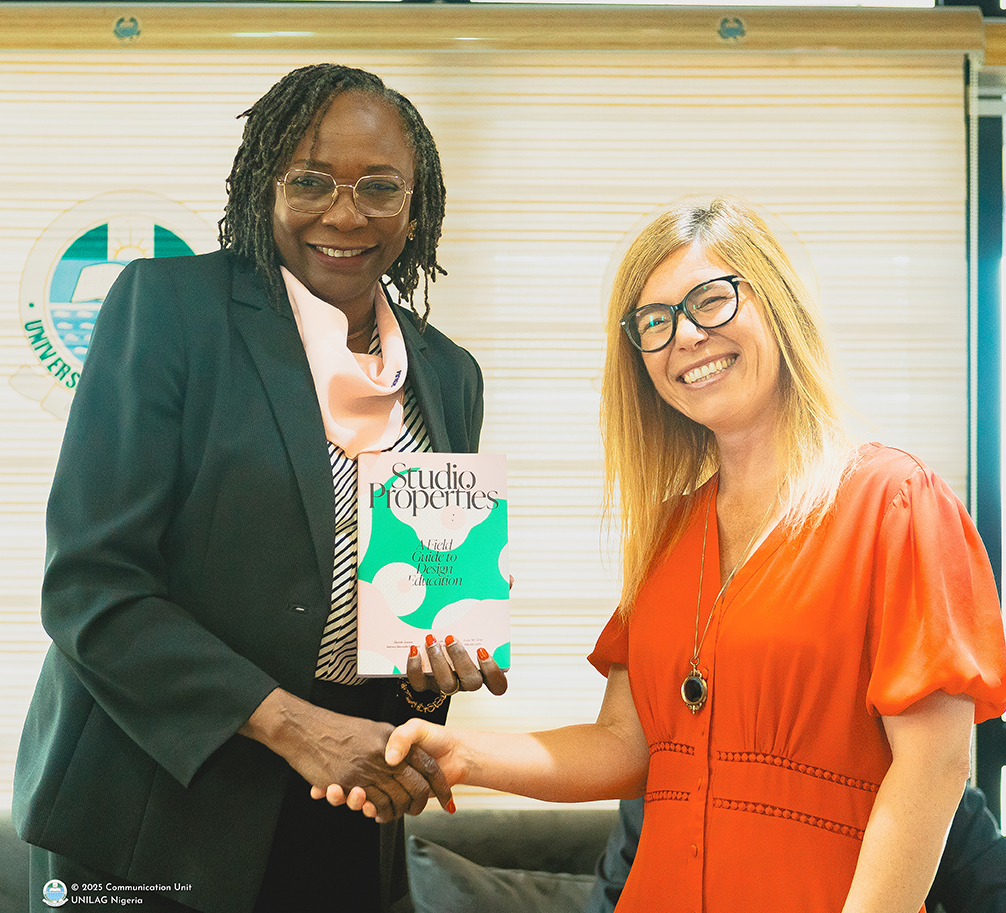
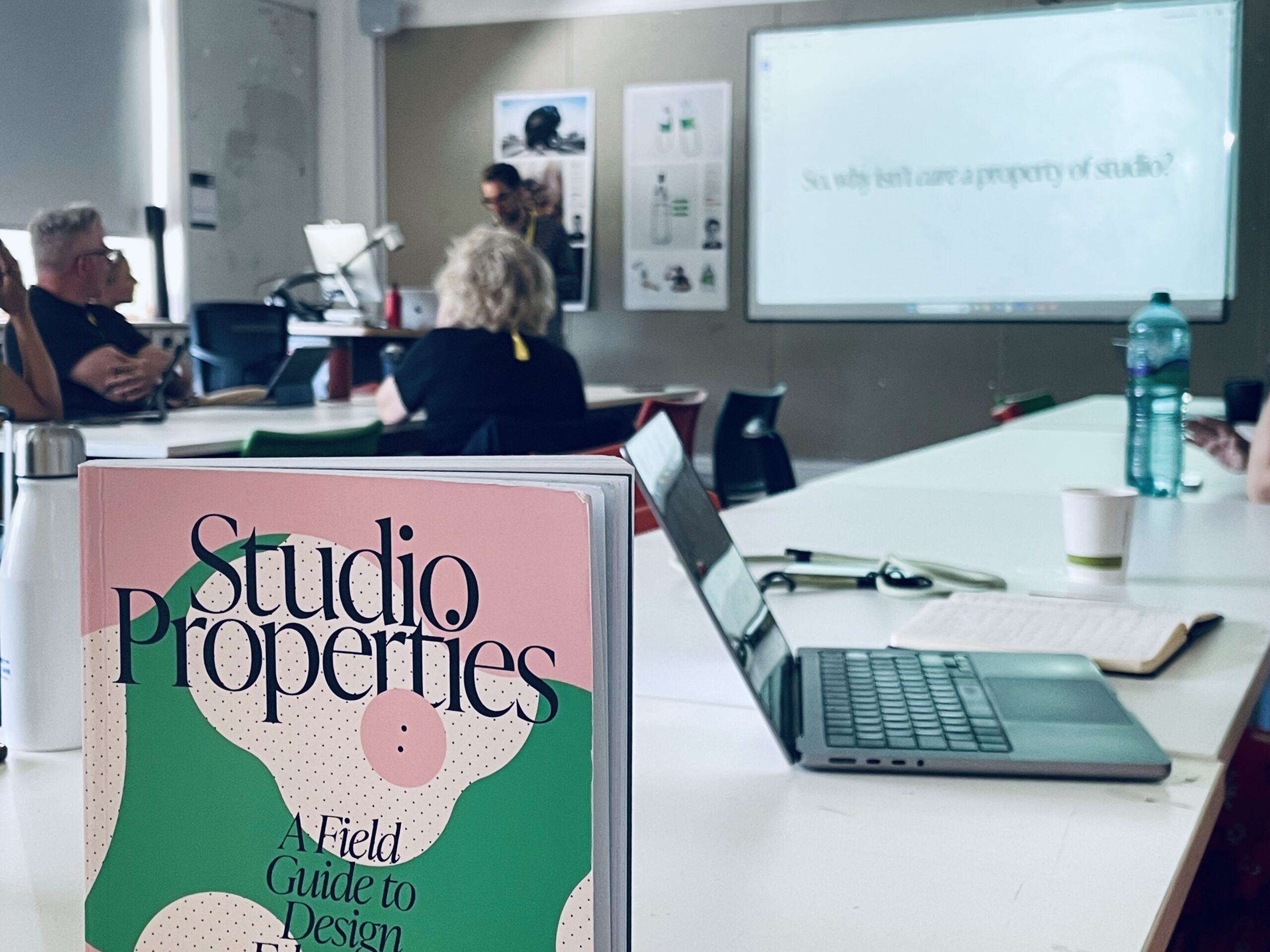
This month, I had the honour of delivering a keynote address at the 4th International Colloquium of the Distance Learning Institute at the University of Lagos. To my surprise and delight, I was also invited to a welcome meeting with the university’s first female Vice Chancellor, Professor Folasade Ogunsola, FAS, OON.
During our conversation, and later in her opening address, Professor Ogunsola shared a perspective that resonated deeply with me. She spoke about how distance and online learning in Nigeria often fails to support the human and social dimensions of education. She lamented the absence of atmosphere, social interaction, and a sense of place, identity, and belonging in current digital learning platforms.
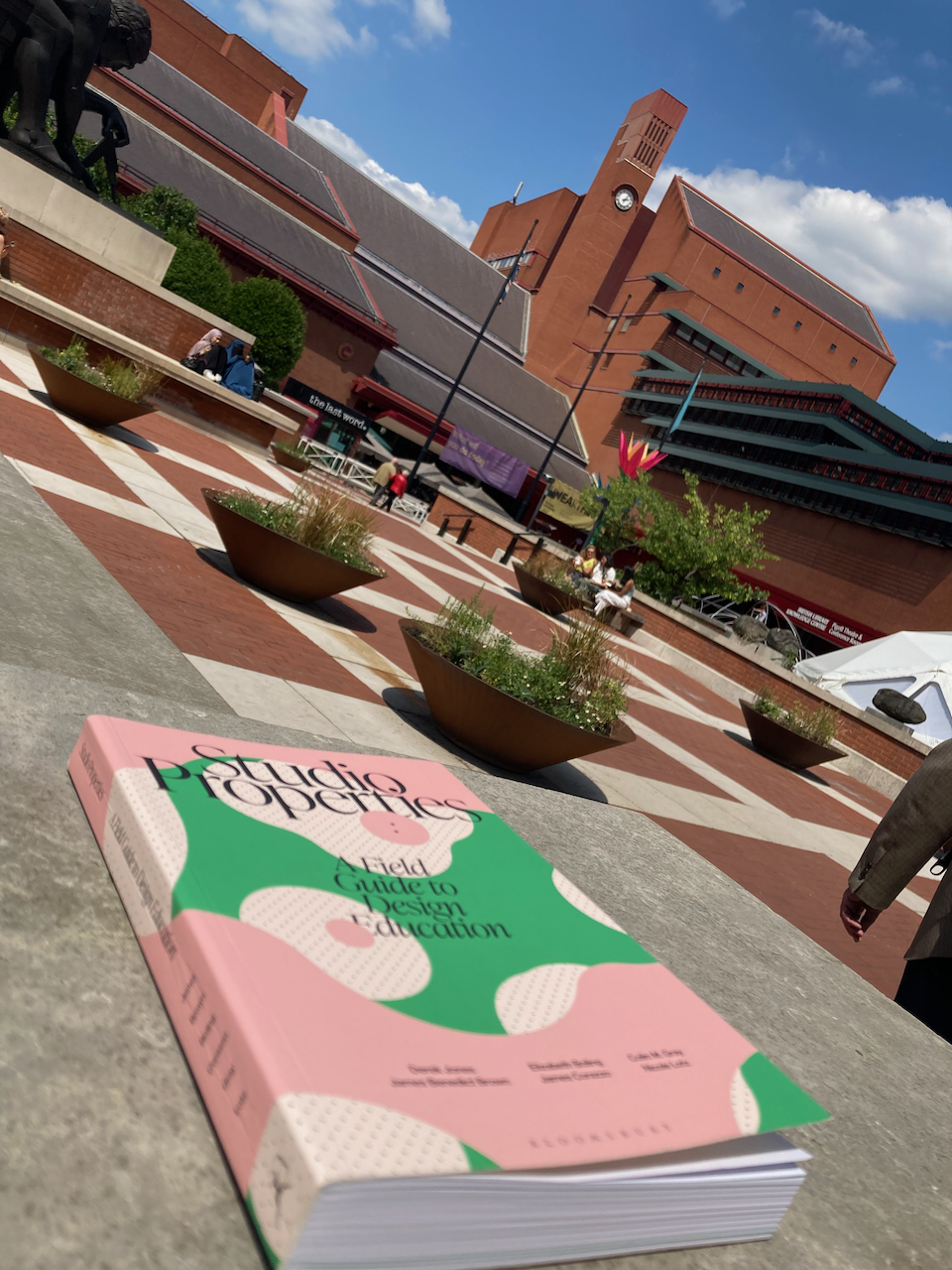
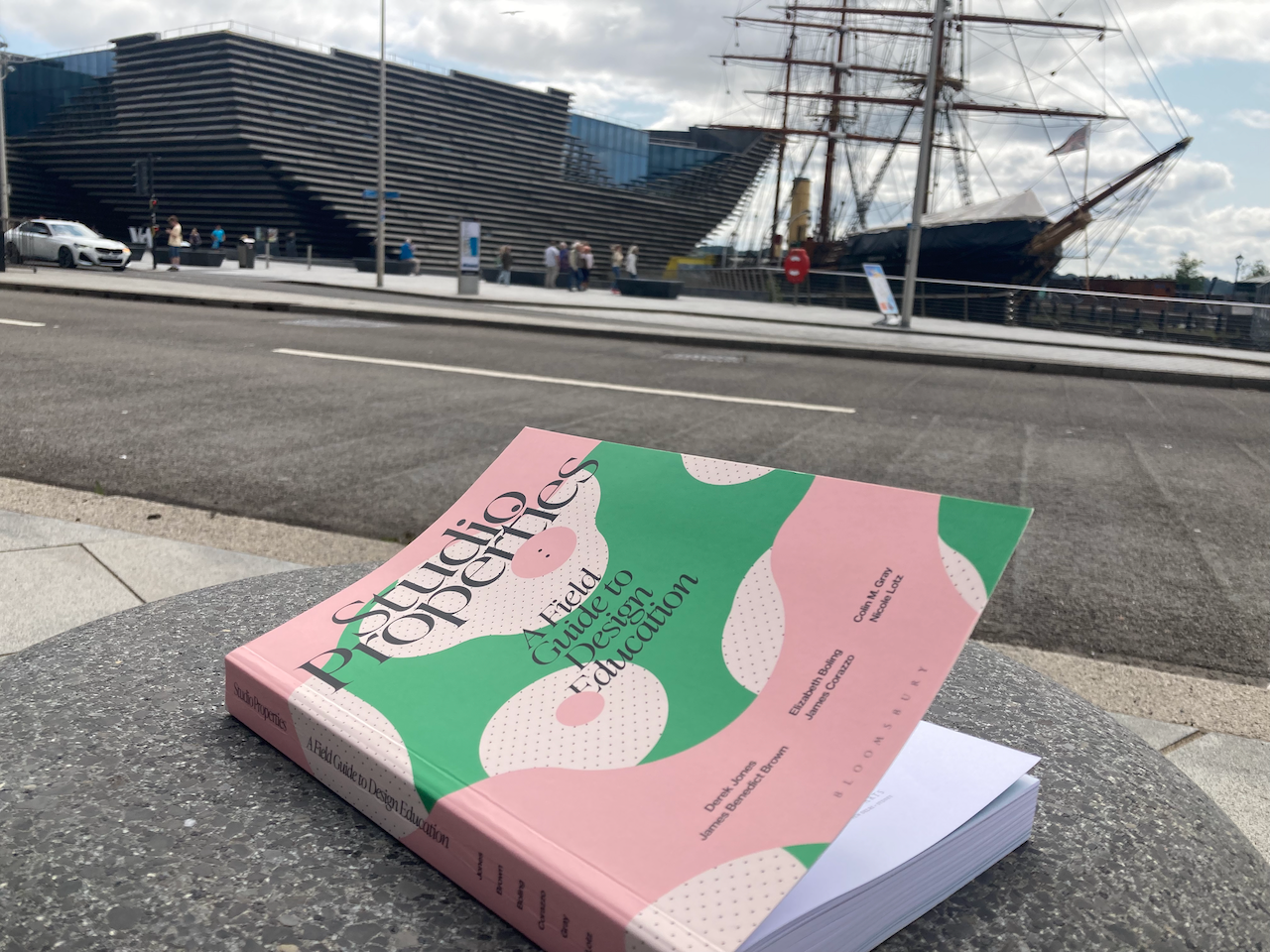
Naturally, I presented her with a copy of the Studio Properties book, suggesting that she might find inspiration in the principles of educational design studios.
The properties outlined in the book are not limited to in-person learning environments. They are equally relevant to hybrid, blended, and distance learning because they reflect the foundational principles of studio learning. For me, the real power of the book lies in how it connects individual Studio Properties and helps the reader form their own ideas about more holistic, humane learning experiences.
In our brief exchange, I identified at least seven studio properties highlighted in [Bold]:
Simply being together in a collective [Collective learning], comprising students from different year groups and specialisations, increases students’ awareness of the surrounding activities, creates chance encounters [Serendipity] and prepares them to act on opportunities to design together. A shared [Place] and shared materials and [Artefacts] offer opportunities for interactions and [Dialogue].
Online learning environments don’t necessarily struggle with embedding those individual properties. The challenge lies in weaving them together to create a cohesive, meaningful experience, a true [Place of identity] and [Belonging] that goes beyond the functional interface.
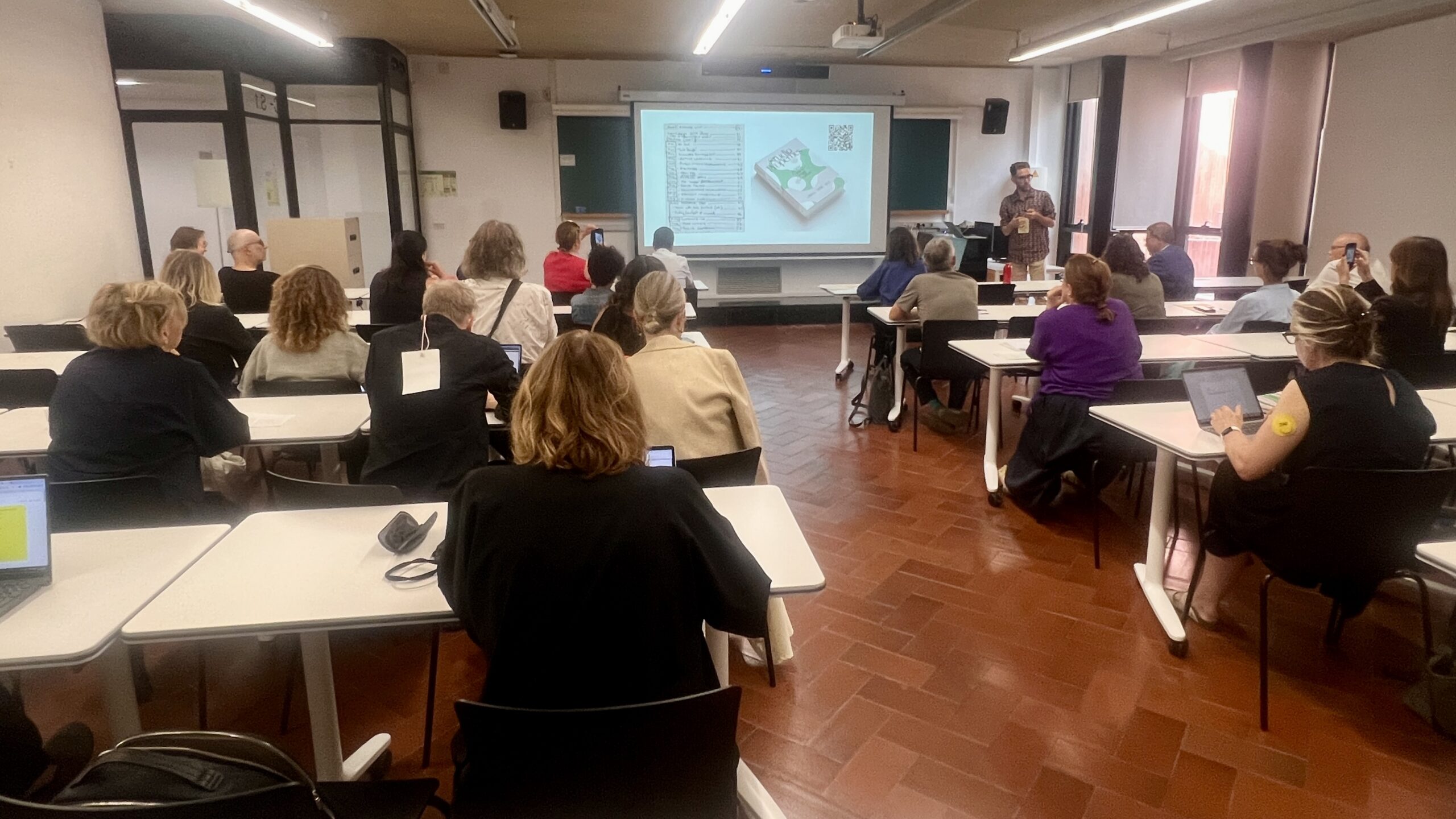
This year, the conference was hosted by the Escola Técnica Superior d’Arquitectura de Barcelona (ETSAB) at the Universitat Politècnica de Catalunya (UPC) under the theme of Transhistorical Pedagogies.
We submitted a paper to Session 4 Skills and Crafts. We took a particular interest in this part of the session’s call for papers:
“Critical thinking and design processes applied to architecture, cities and landscapes require a slow pace. True understanding in these fields requires depth of learning and sedimentation. In a society that values quick results and instant gratification, this commitment to a more deliberate process is radical, even subversive.”
We decided to use this call as an opportunity to present and discuss some of the unpublished research from the book – while also shamelessly promoting the book in its first week of sales. We introduced the book by looking in detail at the cluster Time and Structures, in which the properties Immersion, Time, Rhythms, Synchronicity & Proximity, and Project Cycles all address how the meta-, mesa- and micro-rhythms of studio intersect and interfere with one another to affect the educator’s and student’s experience of studio.
Although we did not name it in the book, we used the conference paper to conceptualise this as the polyrhythmic studio as a means to speculate on how the differing scales of rhythm combine for every student and educator to create a highly personal experience of studio. The challenge for educators is that such time-based architectures are very often invisible, tacit, and assumed, meaning they can be easily dismissed when under-resourced or under cost pressure in the contemporary university.
Studio Properties makes tacit and explicit the properties of studio for educators, giving them tools to examine, surface and articulate the value of studio in the face of increasingly commoditised higher education environments. In particular, it recognises the value of studio as offering: the time and place for immersion and the long durée of a studio experience; the textures of activity in studio as rhythms acting as curricular entities; student agency to create their own learning spaces. Studio Properties challenges reductive ideas of education as immediate, standardised, or transactional and instead argues for the value of studio as a deliberate – and we might suggest – polyrhythmic pedagogy.
Our paper will be further developed based on feedback from conference delegates and will be published in the proceedings later in time for the next conference in August 2026.
Sincere thanks to the conference organisers, scientific committee and delegates for an engaging and enjoyable conference. And for supplying chilled Cava in the 36° heat.
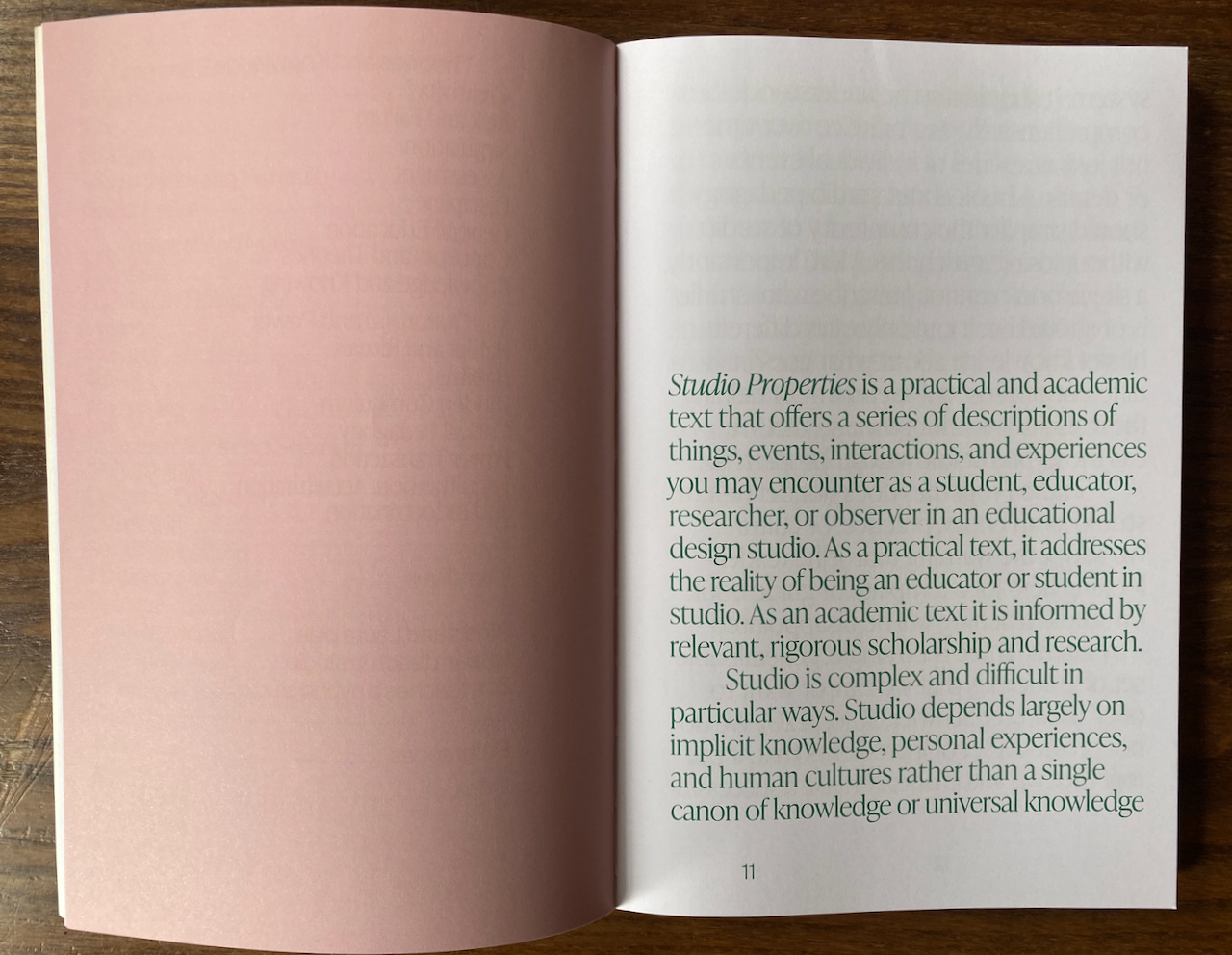
All the properties in Studio Properties are phenomena you might encounter in a design studio in an educational institution. Some of them you might never have experienced, and some you might encounter every day.
Some are different, in the sense that they are properties of many educational environments, not just studio. In the cluster Cultures and Power the property Critical Pedagogy rests on extensive bodies of knowledge from a range of educational contexts.
Critical pedagogy names and addresses the inequities and injustices in education. It is an approach to education that regards teachers and students as equally responsible for co-creating the curriculum. Fundamentally, critical pedagogy seizes the political potential of education as means of liberating both teachers and students from forms of oppression.
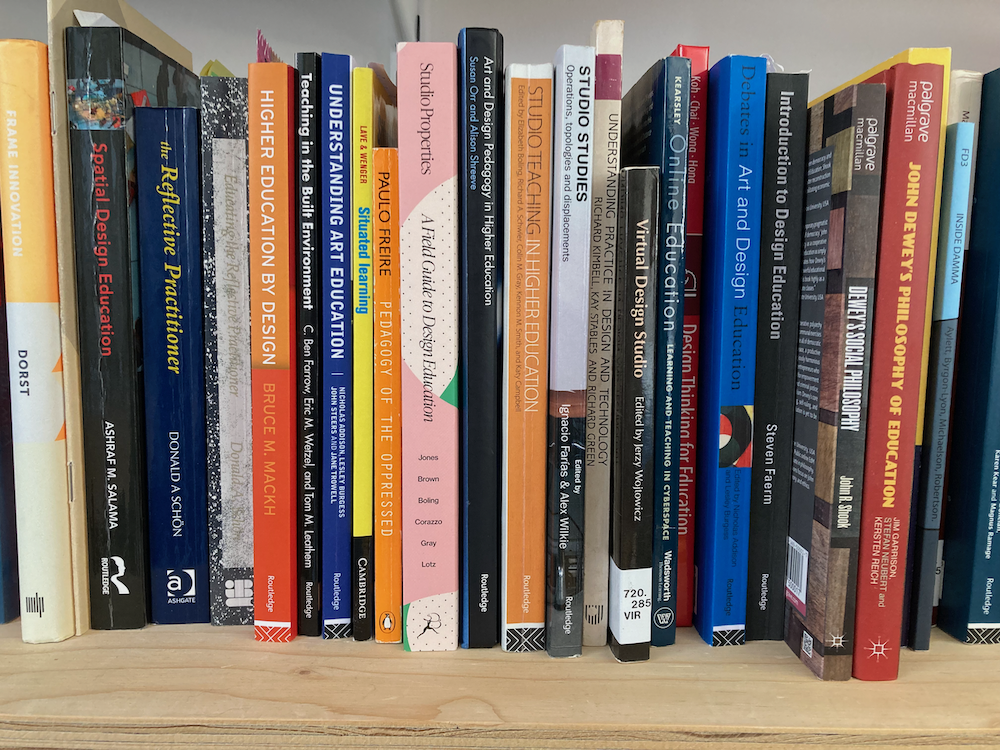
Like many teachers who identify with the tenets critical pedagogy, I first encountered Paulo Freire’s Pedagogy of the Oppressed as a student, in my case during a seminar course at the University of Sheffield taught by Rosie Parnell, now Professor of Architecture and Pedagogy at Newcastle University. Rosie included the book as part of a wide ranging reading list that allowed us as Masters students the opportunity to interrogate the extent to which we were in control of the form and content of the knowledge we were learning.
Freire based his writing on a model of literacy education for rural farmers (far removed from studio education in architecture). Much of what has followed in my subsequent two decades of educational research and practice has been related to a fundamental question: to what extent can architectural education fully engage with the principles of critical pedagogy? And I am living up to the liberatory principles of critical pedagogy in my own teaching?
What is perhaps most exciting about critical pedagogy in studio is its possibility for supporting teachers and students to collaboratively build a framework for embodied and empathetic action, one which is simultaneously pedagogical and political.
Educators in design disciplines can engage with the principles and values of critical pedagogy in various ways. As a Masters student, I first started to think practically about applying critical pedagogy to design education during annual live projects at the University of Sheffield School of Architecture. These six-week-long projects introduced groups of students to a real client and community outside the university. Sometimes these groups both designed and built small structures for their clients, but in many cases, their work was focused on researching and presenting feasibility studies or design proposals that the client could then take forward. By developing a response to a real person, a real situation and a real need (as opposed to a theoretical design brief written by a teacher or the student themselves) students are exposed to the complexity and richness of designing in the real world. They develop empathy for the clients and communities they work with, and their design work becomes embodied.
Live projects were already the subject of doctoral research, notably Rachel Sara who coined the concept of them existing ‘between the studio and the street’. Her work emphasises that while live projects give students an opportunity to design outside the simulacra of design practice in the studio, they also reinvigorate the studio as a place of critical reflection and discussion.
In my subsequent research, I came to understand live projects as critiques of normative educational models. By engaging students with the world outside the studio, live projects require students to critically examine their assumptions about the knowledge and skills required by the curriculum.
As we explain in the property Critical Pedagogy, while critical pedagogy can be a property of studio, it is not an innate property of studio. Furthermore, while certain aspects of critical pedagogy can be found in studio practices and approaches which are widespread – they are not always recognised as such. We have observed many studios operating which seem to be opposed to the principle of teachers and students being co-creators of a curriculum of liberation. This may be understandable – to be a critical pedagogue in studio requires determination to overcome the deeply embedded power structures of the university.
Should a book about the educational design studio include a definition of studio? Probably. Have we defined studio in Studio Properties? Umm … yes … and … no. Studio is challenging to define. It just is. The complexity and ambiguity of studio makes it difficult to describe and pin down. Yet, at the same time, the complexity and ambiguity of the studio is precisely what makes it work. It turns out that the simple question – ‘what is studio?’ – isn’t so simple. Studio slips and slides when you try to describe it – as you will know if you’ve ever listened to a group of educators talking about studio or engaged with the research literature.
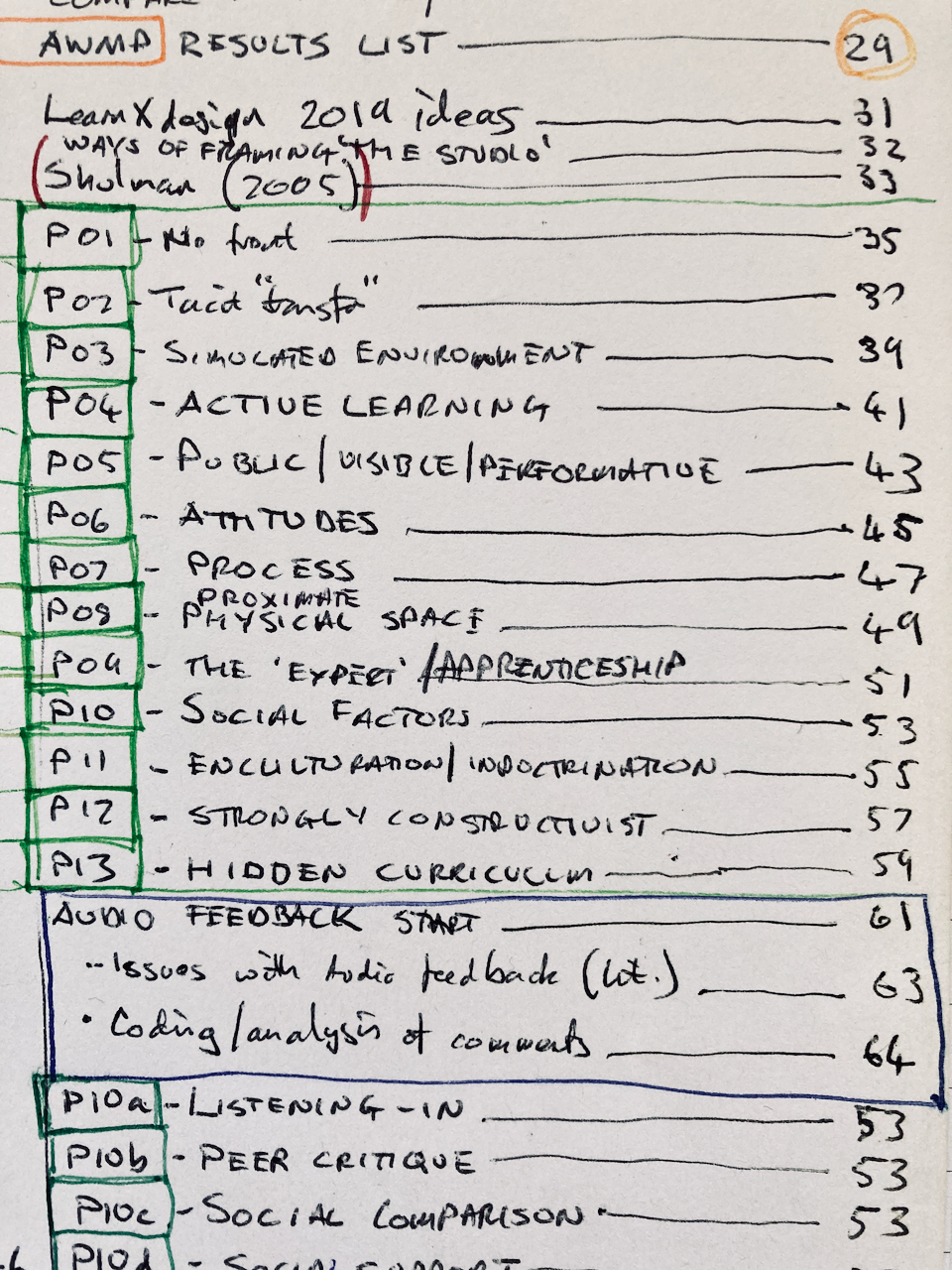
With Studio Properties, we never directly addressed a definition head-on, but we did engage with the question: ‘what is studio?’. Our approach to this question was emergent, and it started from a list of terms in Derek’s notebook.
Derek’s list consisted of what people said or wrote when they described studio education, and he referred to it as a list of ‘properties of the studio.’ We began to add to the list. Our initial idea for the book was to document the ‘properties of studio’ and, in the process, build a picture of studio education. Reasoning, if we could be comprehensive in describing the properties of studio, a more distinct and precise shape would emerge, and we would have an answer to the question: ‘what is studio?’
As our collective list of properties grew, however, we weren’t getting any closer to answering that question. What we had was emergent, but it was also very messy.
Studio as a Messy Object The social theorists John Law and Val Singleton coined the term messy object to describe things or ideas that appear to defy knowing: “Mess is other to clarity, systematic study and knowledge. It defies knowing.” (2003, p.2). Messy objects confound researchers, not because they can’t bring clarity, but rather, it is a condition of the object itself. In other words, researchers cannot tidy up messy objects.
While it certainly felt to us like studio defied knowing, we were also mindful that simply labelling something a messy object is not enough. In the face of such a messy object, how could we offer some clarity or a heuristic framework that describes studio, that structures the messy object in a way that makes it accessible for others to understand, without being the actual structure of the studio? Bringing clarity to a messy object that defies understanding became the central conundrum of this book.
How did we solve that conundrum? The book has an unconventional structure; it doesn’t have chapters, and we didn’t write it as a linear account of the studio. Instead, it comprises 57 properties clustered thematically.
Image above: A double-page spread showing the nine thematic clusters.
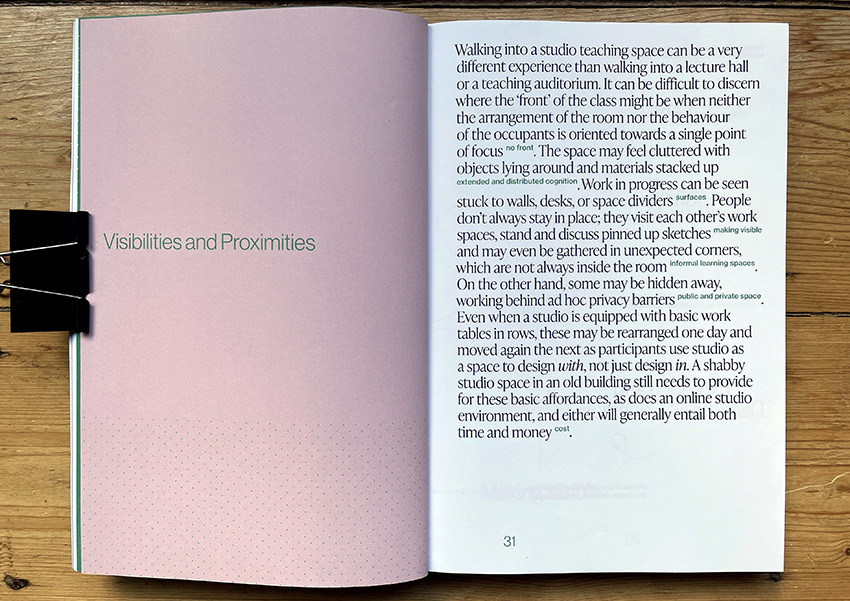
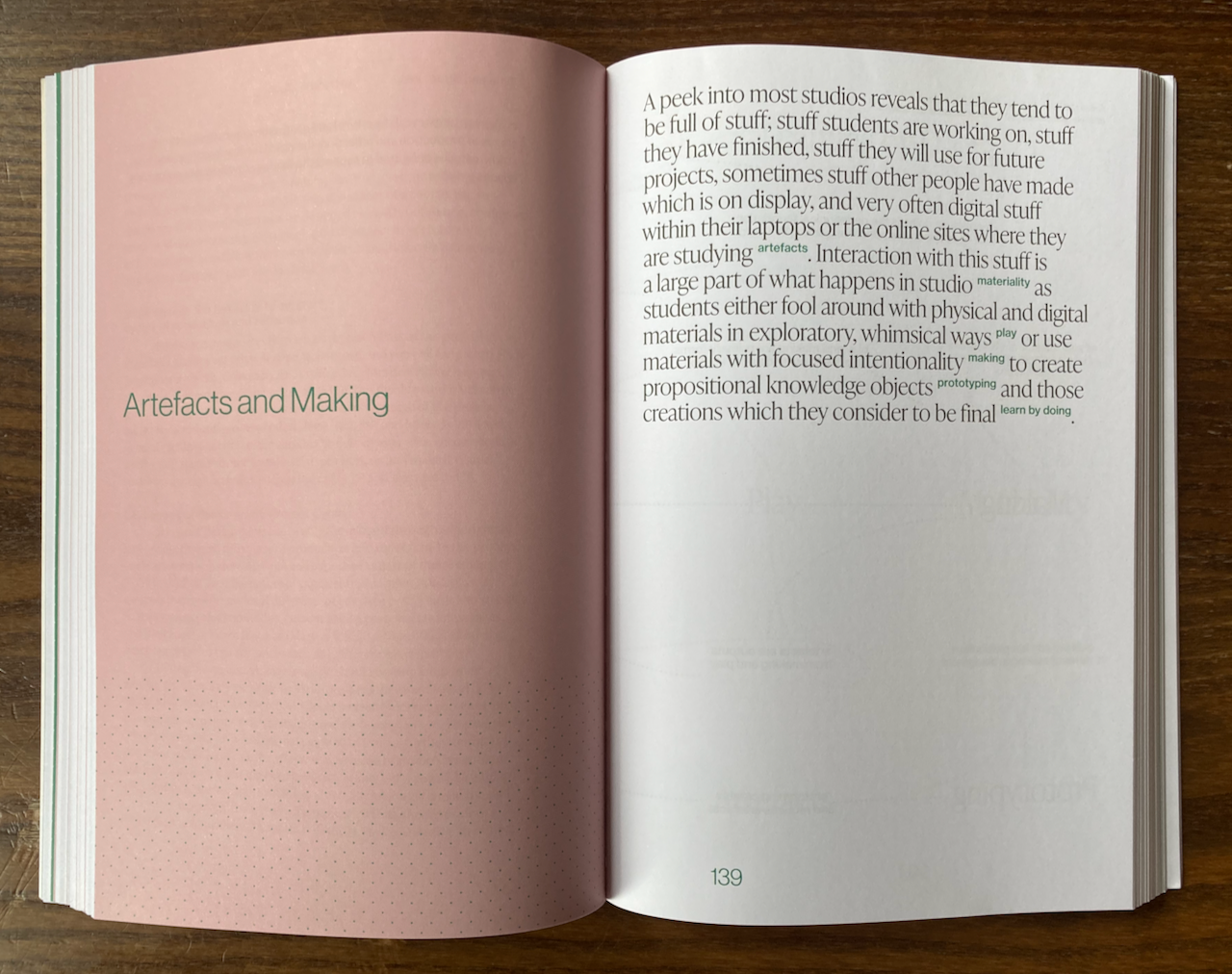
Image above: At the start of each cluster, a single paragraph connects the properties in that cluster.
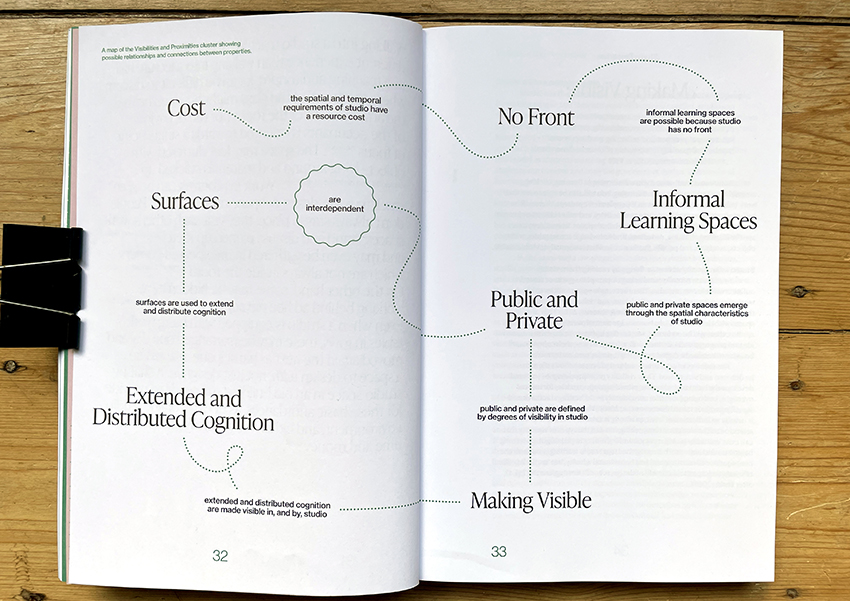
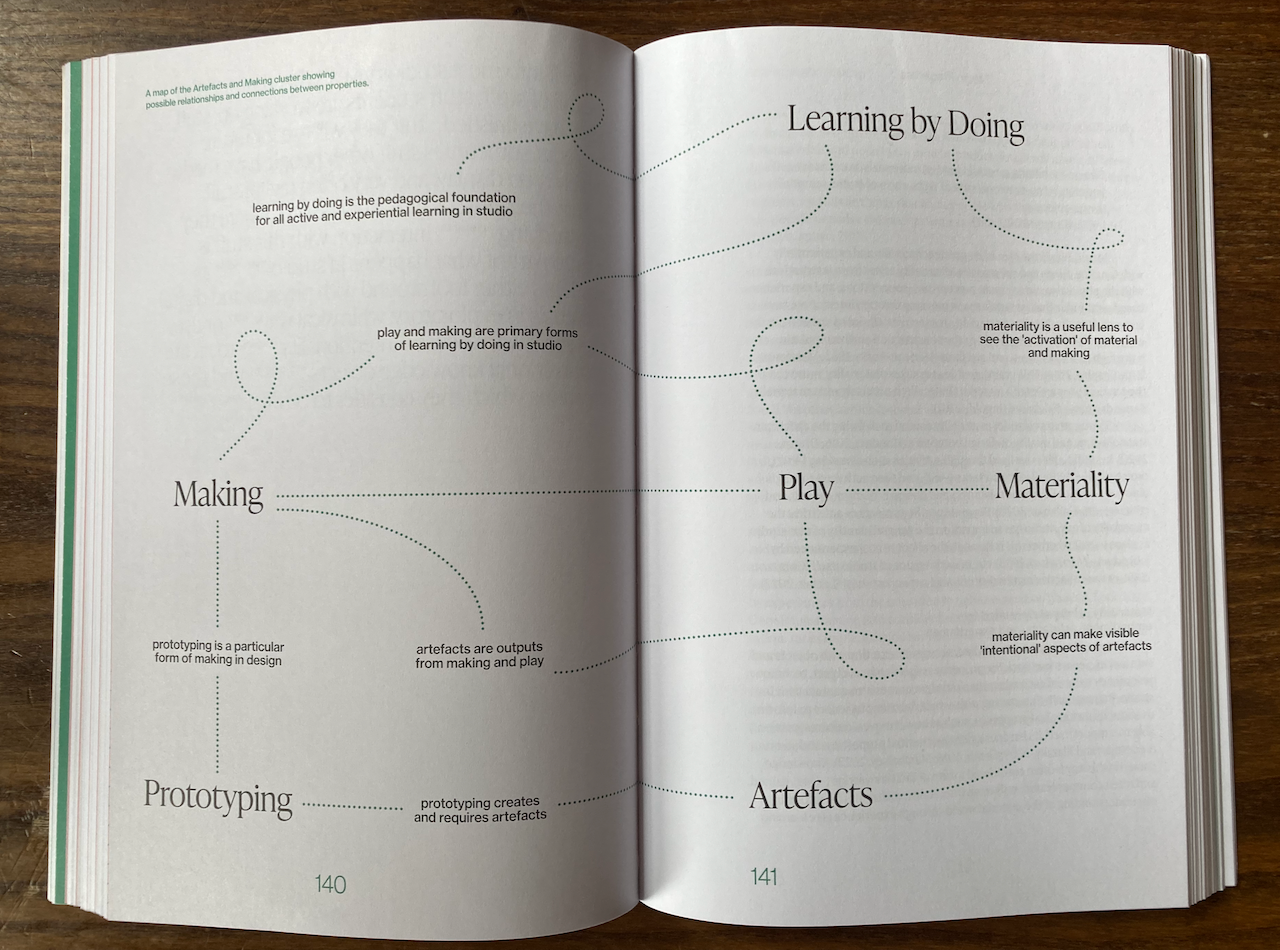
Image above: The connections between the properties in a cluster are also presented in a diagram to provide the reader with a visual representation of the cluster.
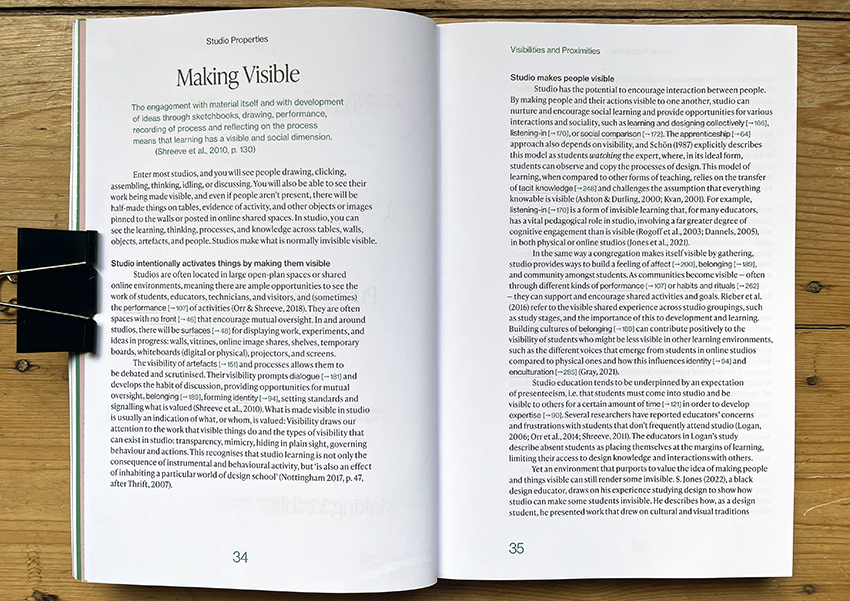
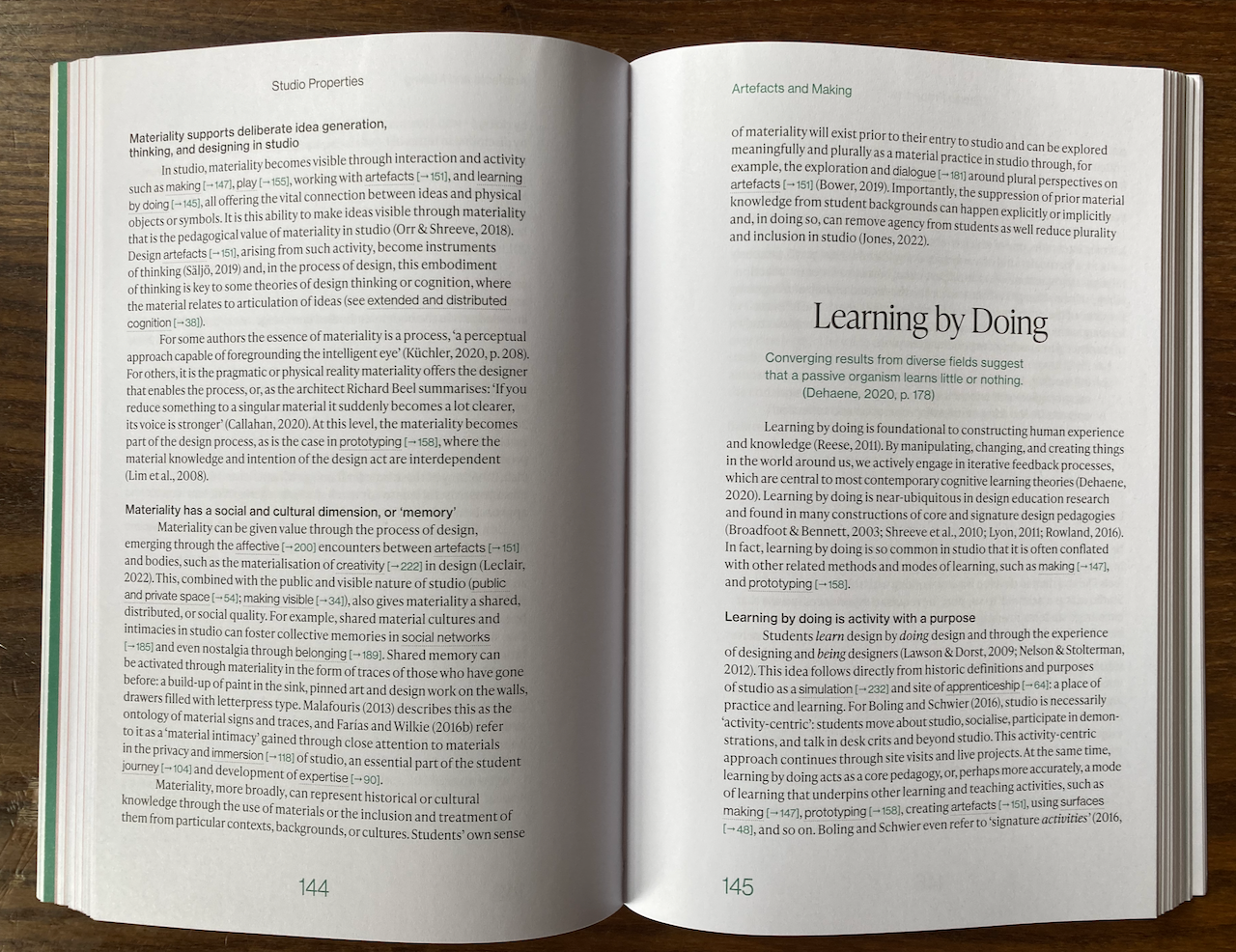
Image above: The heart of the book is made up of individual properties.
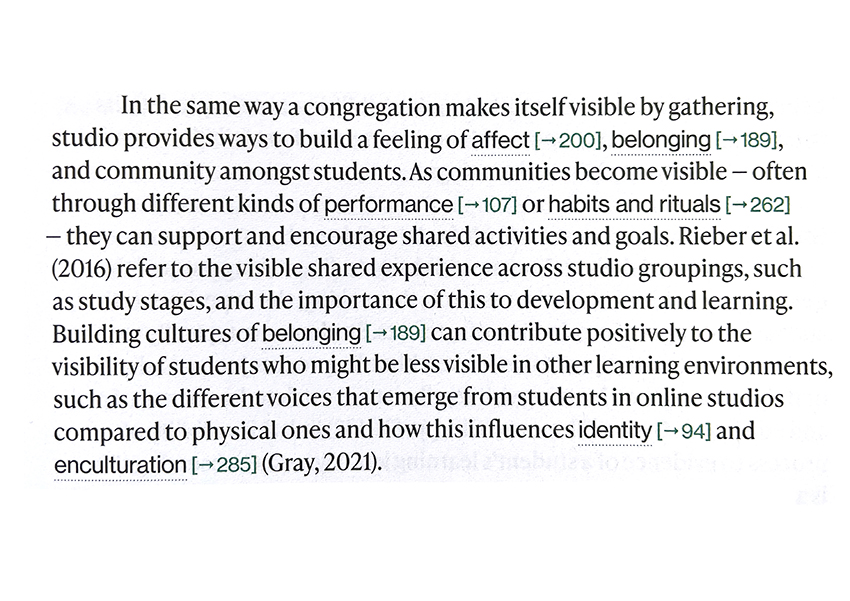
But perhaps the most important contribution the book makes, and our strategy for dealing with the messy object of the studio, is not so much the properties themselves, but rather the connections between them. Each property references multiple other properties, creating a web of interconnected patterns. In the text snippet below, taken from ‘Making Visible’, we can see that the properties of affect, belonging, performance, habits and rituals, identity, and enculturation are all mentioned in a single paragraph.
Image above: Close-up of a paragraph from Making Visible Property, which shows how the connections to other properties are integrated in the text.
In this way, the book is hypertextual – it exhibits characteristics of a wiki, a field guide, and a pattern language (see Alexander, Ishikawa and Silverstein 1977 A Pattern Language). We adopted this approach to circumvent the perennial challenge of systematic study, which often breaks things down into constituent parts and then examines the parts. This method risks not seeing the whole or the relationships between parts. With Studio Properties, we have created a book that enables readers to navigate between the whole and its parts and understand the “mutually elaborative” interconnections between properties.
Studio Properties doesn’t offer a definition of studio, but we have attempted to answer the question ‘what is studio?’by cohering the messy object (studio) into a series of relationships in ways that are productive for educators, researchers, students and advocates of studio education.
Law, J. and Singleton, V. (2003), ‘Object Lessons’, published by the Centre for Science Studies, Lancaster University, Lancaster LA1 4YN, UK, at http://www.comp.lancs.ac.uk/sociology/papers/Law-Singleton-Object-Lessons.pdf
Traditional studio spaces (sometimes dedicated 24/7 to individual students or classes), tutors who engage intensively with low numbers of students, studio hours which gobble up chunks of the curriculum, as well as multiple types of technology and tech support – all of these impact higher education budgets without doubt.
At a time when those budgets are stressed and under scrutiny organizational conversations around managing the cost of studio veer from the “suck it up and rotate (ever larger) classes through the studio space” variety to the “it’s a miracle – student-owned laptops and AI tutors will eliminate equipment and personnel costs” variety. Either of these tends to result in cost cutting measures which, at best, lack nuance and at worst cost more than they were intended to save.
What could happen if we engaged in such discussions informed by the ways in which properties of studio may be engaged, leveraged or impinged upon as different dimensions of cost are targeted for reform?
Consider some common efficiency moves regarding the cost of physical space: eliminating the dedicated space traditionally accorded to studio by rotating design students through these spaces for limited “studio periods,” eliminating open-ended studio spaces and moving just tools and equipment to a shared lab visited by students on as as-needed basis, or even taking studio online and eliminating the space requirement altogether. The property foregrounded in such moves may well be Cost, put forward as the argument for getting rid of the spaces. On the other hand, several properties may be used to argue that these spaces are essential. These can include: Place, or the physical and emotional space in which design work happens; Surfaces, which serve both as workspaces and support for creative processes and interactions; and Artefacts, the physical or digital products of the design process, which include not only the students’ work, but the exemplars, materials samples, and a range of objects used in both teaching and learning.
Assuming good faith intent to address cost dilemmas, what might be some questions raised in a properties-based discussion of, for example, the cost to institutions of physical studio spaces?
What are some interdependent properties linked to Surfaces, Artefacts and Places (e.g., Listening in, Confidence to speak, Extended and distributed cognition)?
By what means might some of those properties be supported in alternative spaces or digital spaces? (Many are, BTW, in currently realized studio programs and these could be investigated for their perceived or proven efficacy.)
Recognizing that these interdependent properties should be supported, what are the relative costs of doing so viably in alternative spaces versus whatever might be the current physical space?
The outcomes of such discussions might bring to light false economies inherent in some potential solutions to the “cost of studio” dilemma for organizations, mitigating against seemingly obvious but uninformed decisions. Equally, design educators might be able to argue more effectively than dogmatically the complex value to education being realized in a physical studio and possibly to entertain viable – even attractive – alternatives.
I posit that the question to be asked about the cost of studio is a design question, not essentially a financial one. It is a question posed, as every design question is, within existing limitations, including fiscal limitations. That question is, “how may the complex and interdependent properties of studio education be given effective form?”
With the publication of Studio Properties little more than a month away, from 9-11th July 2025, I had the pleasure to meet friends old and new at the 2025 AAE conference hosted by the University of the West of England (UWE) outside Bristol, England.
(Short background: I was a founding committee member of the Association of Architectural Educators, and formerly Assistant Editor and later Editor of its open access journal Charrette. The AAE emerged after the Centre for Education in the Built Environment (CEBE) was dissolved by the Higher Education Academy, and architecture educators came together to form an association to represent their interests and to disseminate their work.)
This was my first AAE conference in many years, but it was also my first time speaking about the book with a printed copy in my hands. It was a delight to be able to introduce the work and hand the book over to the audience. Glimpsing between my notes, the presenter preview and the room, it was a delight to see the book in the hands of some twenty architecture educators from the UK, continental Europe and North America.
We argued that practices of care are rarely explicit in architecture curricula, but can be found in healthy and inclusive studios. We believe that studio, as a place of learning intertwined with its occupants’ emotional states and experiences, constitutes a distinct and exceptional environment for developing pedagogies centred on care.
During the conference I was informed by a member of staff that UWE currently pays studio teachers a lower hourly rate than those engaged in other modes of teaching (such as lectures). Given the drastic contractions in UK Higher Education, this was a poignant reminder that effective studio education has a high cost in terms of time, facilities, resources, and people. Many universities are turning their attention towards expensive teaching modes and demanding savings. As we argue in our paper, studio educators need a language to explain and defend the values of studio as a place of critical care. We hope that for some, Studio Properties can provide that language.
Our paper will be further developed based on feedback from conference delegates and will be published in the proceedings later this year.
Sincere thanks to the conference organisers, scientific committee and delegates for an engaging and enjoyable conference.
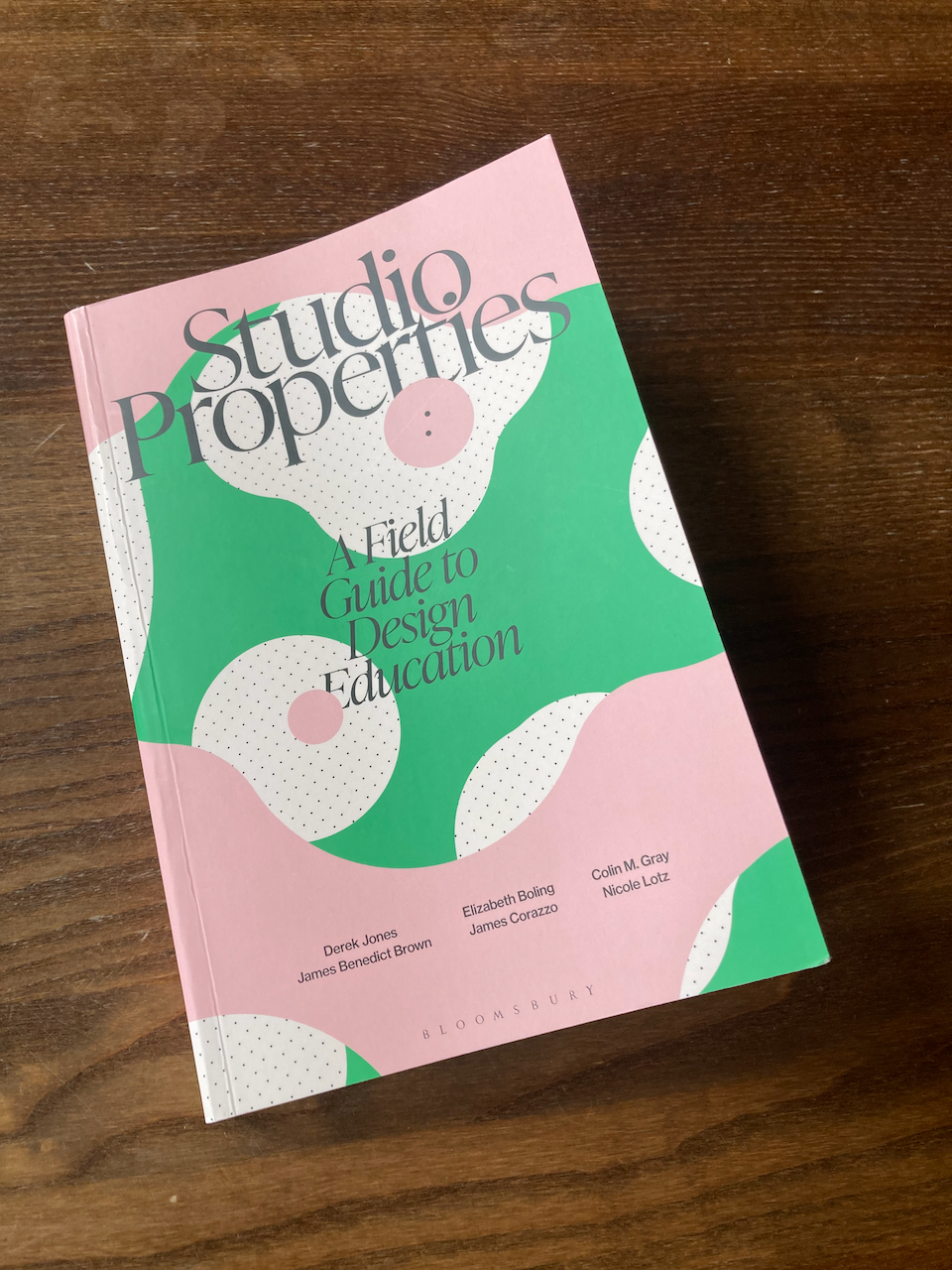
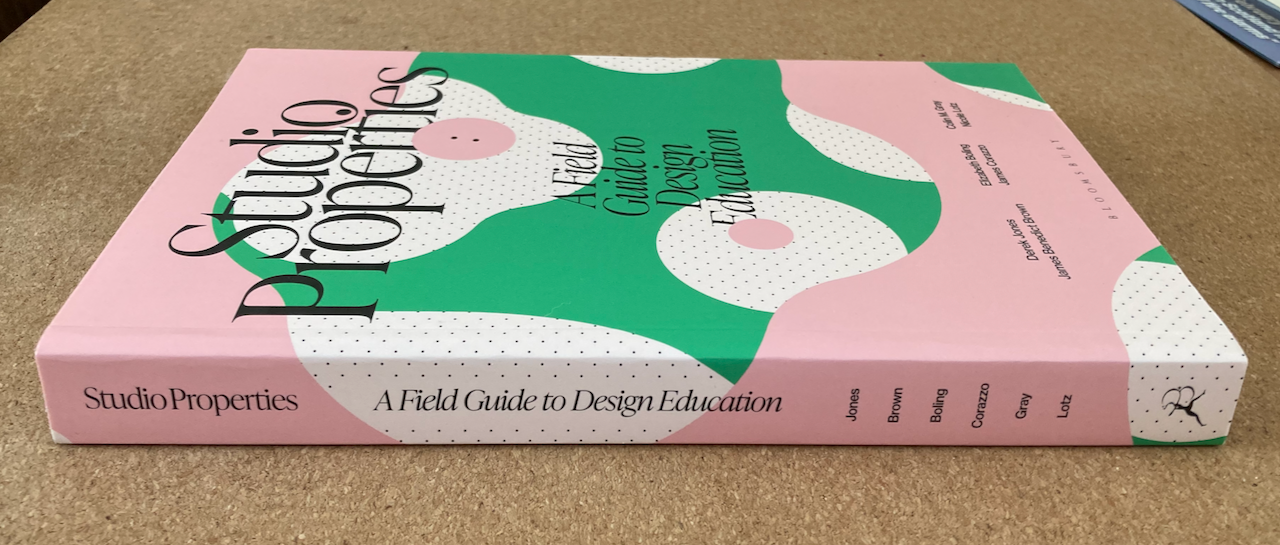
This is a quick post about the physical book itself: the Artefact [> 151] that is Studio Properties.
I’m not exaggerating when I say that we spent a long time designing the book. From the start we wanted a book that could be used; that spoke to a design audience; and that was a design Artefact [> 151].
And I really think we achieved that.
Here’s a few highlights.
It just looks good, making it feel good
Some of the layouts are just stunning examples of that magic that good typography, graphic, and layout design come together.
They allow space for the type, text, headings, and all that other stuff that makes up a book (this is Page Furniture according to a fellow author … /cough). Studio AW–AR Studio were just awesome at this all the way through.
Proper book designers are worth it. Who’d have thought.
It has utility through design
The book has materiality [> 142] that has been used to make it look great but also have utility through design. Again , this was something we really wanted to happen – it’s a complex book that also must be useable.
That’s achieved through good design.
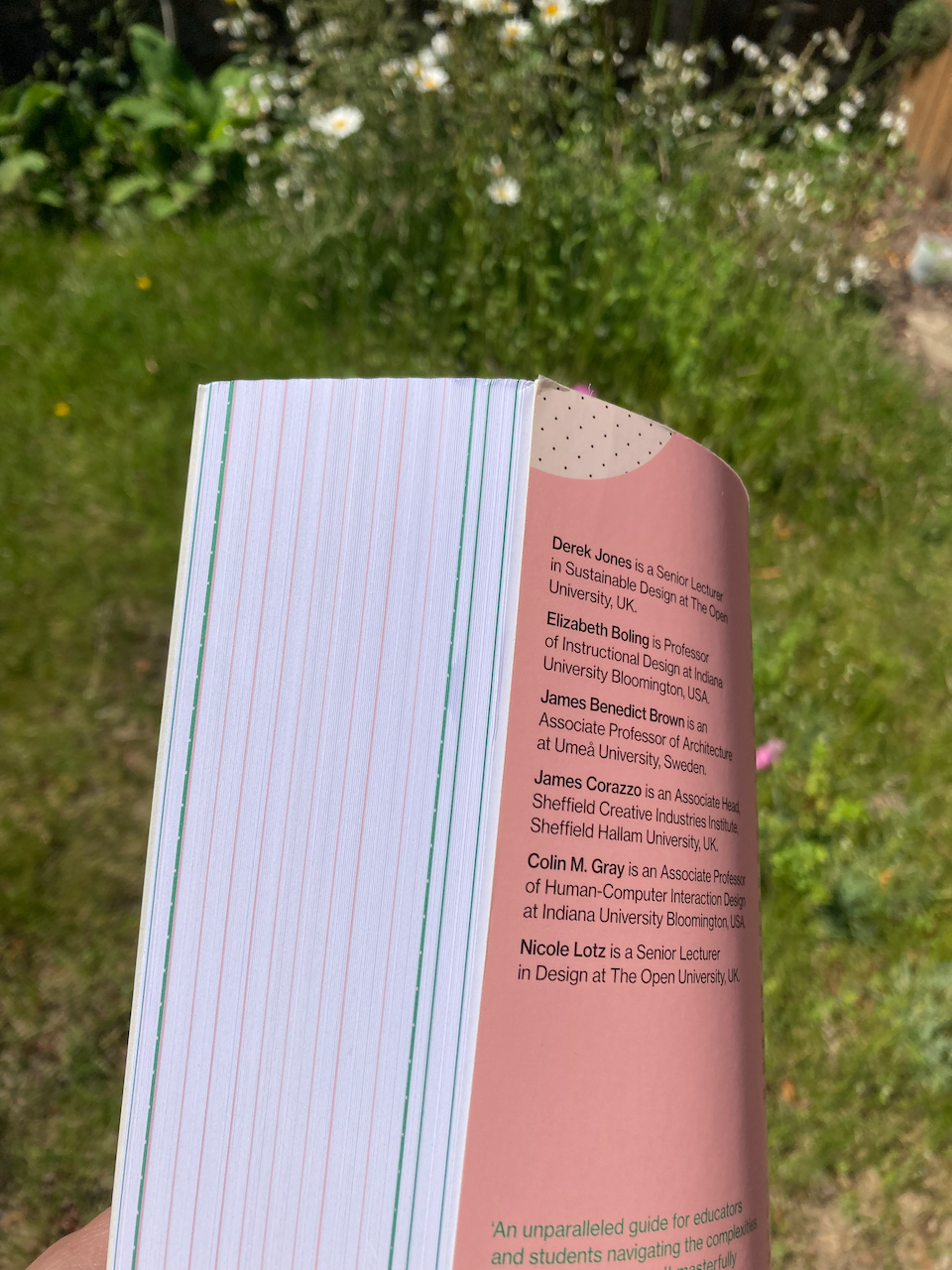
For example, the way the pages fan and give a clue as to the big structure of the text is lovely. We’d had a notion of doing this from the start but the designers have pulled this off really nicely without it screaming at the reader or getting in the way.
That subtle pink that emerges when you flick through Studio Properties is tasty.
Did I mention that it just looks good?
Speaking of tasty, that pink on the cover is absolutely lickable.
This is my word and both my fellow authors and spell checker do not like me using it. But I’m with the late Steve Jobs on this: making the book edible makes it touchable; acceptable; and delicious. (my only slight sadness is that the custard and rhubarb colour scheme I voted for was unanimously rejected… I defy you, enemies of progress!)
Studio Properties is visually edible and digestible.
It feels meaty
Finally, I’d like to talk about heft. In the context of book design, I’m going to trademark the term Heft ™ as “The appropriate weight for a given set of content in a given knowledge context”.
We had well over 100 properties at one point and, besides the wonderful Bloomsbury pointing out the 7 volume absurdity of this, I am glad we ended up with what we did. It’s a perfect starting point because it’s just right: it’s a lot of material but it doesn’t feel like too much (and I really love the spine design…).
Studio Properties has a Heft (and Girth) appropriate as to its position in design education research…
OK, that’s probably enough now. I can hear the other authors at the door, begging me to stop typing and step away from the laptop.
Buy a physical copy of the book if you can to truly appreciate the tastiness, digestibility, and heft of Studio Properties!
The book comprises properties, clusters, and narratives. Properties describe things, events, interactions, or experiences in studio education. Clusters are groups of properties that are thematically related. Narratives offer a first-person account of studio, and have been created to provide insight into how properties interrelate, overlap and depend on one another.
Each offers a different way to view, explore, and understand studio through its parts.
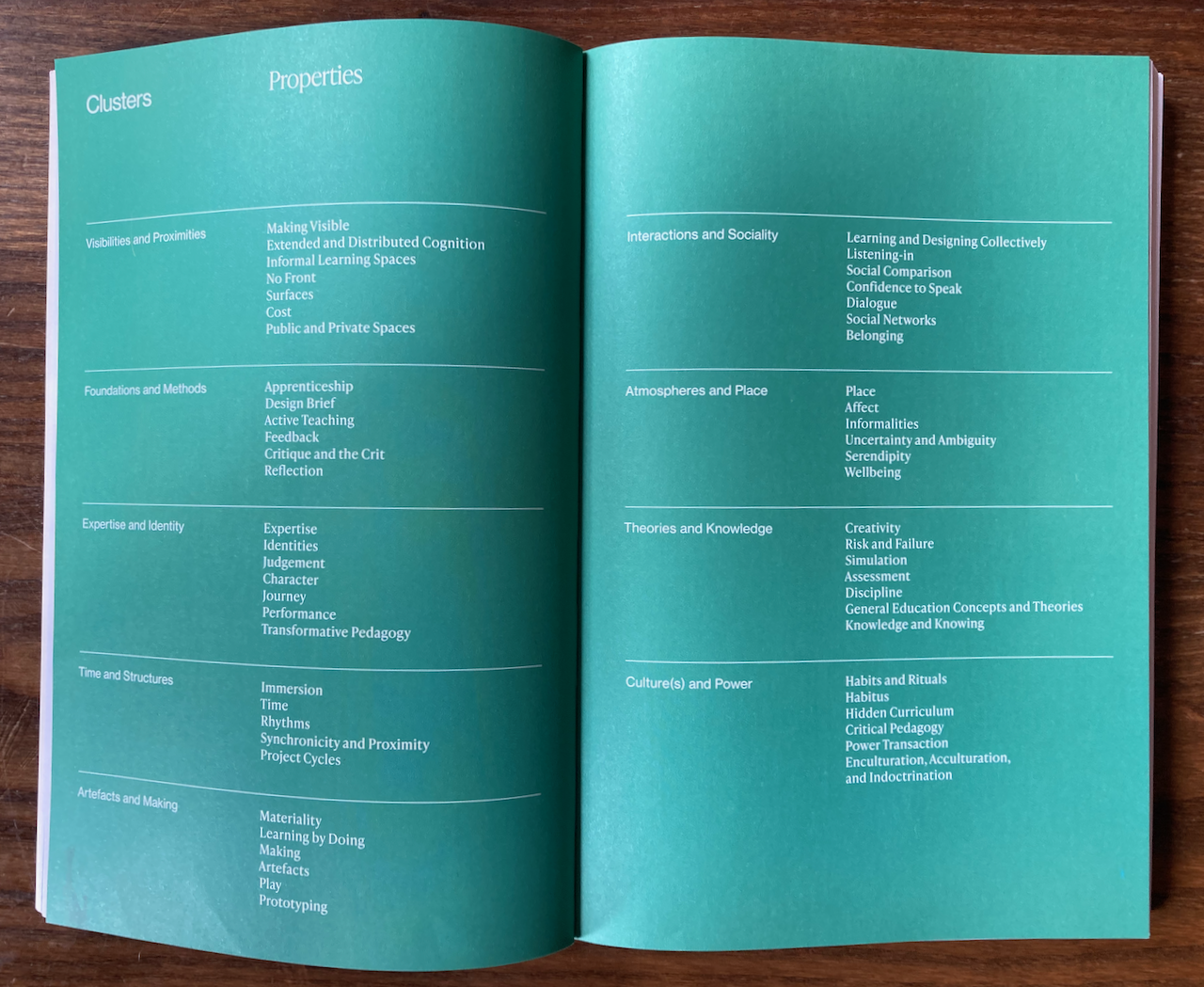
To give you an idea of how these go together, here’s the list of properties and clusters from the book.
Visibilities and Proximities
Making Visible Extended and Distributed Cognition Informal Learning Spaces No Front Surfaces Cost Public and Private Spaces
Foundations and Methods
Apprenticeship Design Brief Active Teaching Feedback Critique and the Crit Reflection
Expertise and Identity
Expertise Identities Judgement Character Journey Performance Transformative Pedagogy
Time and Structures
Immersion Time Rhythms Synchronicity and Proximity Project Cycles
Artefacts and making
Materiality Learning by Doing Making Artefacts Play Prototyping
Interactions and Sociality
Learning and Designing Collectively Listening-in Social Comparison Confidence to Speak Dialogue Social Networks Belonging
Atmospheres and Place
Place Affect Informalities Uncertainty and Ambiguity Serendipity Wellbeing
Theories and Knowledge
Creativity Risk and Failure Simulation Assessment Discipline General Education Concepts and Theories Knowledge and Knowing
Culture(s) and Power
Habits and Rituals Habitus Hidden Curriculum Critical Pedagogy Power Transaction Enculturation, Acculturation, and Indoctrination