With the publication of Studio Properties little more than a month away, from 9-11th July 2025, I had the pleasure to meet friends old and new at the 2025 AAE conference hosted by the University of the West of England (UWE) outside Bristol, England.
(Short background: I was a founding committee member of the Association of Architectural Educators, and formerly Assistant Editor and later Editor of its open access journal Charrette. The AAE emerged after the Centre for Education in the Built Environment (CEBE) was dissolved by the Higher Education Academy, and architecture educators came together to form an association to represent their interests and to disseminate their work.)
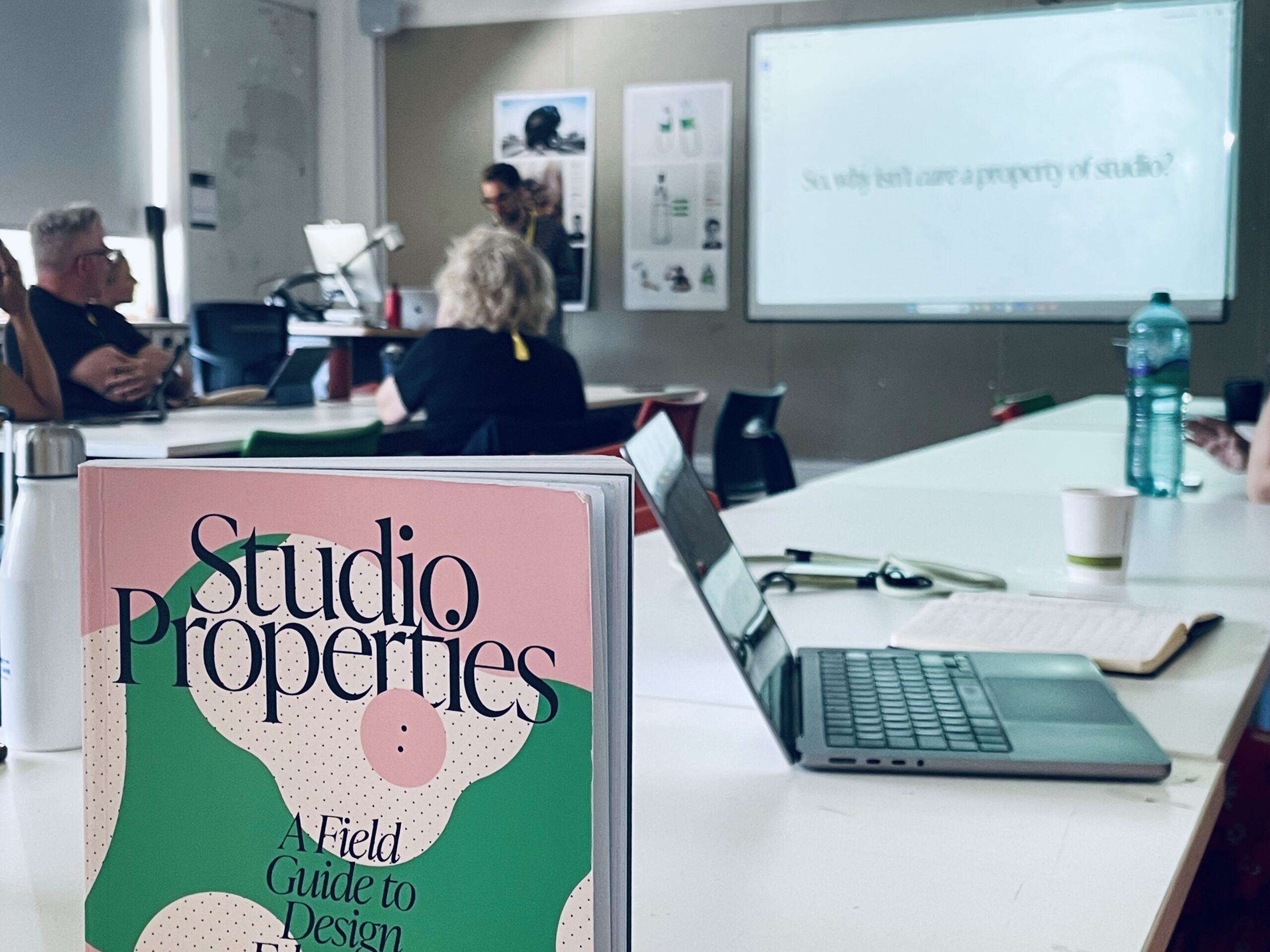
This was my first AAE conference in many years, but it was also my first time speaking about the book with a printed copy in my hands. It was a delight to be able to introduce the work and hand the book over to the audience. Glimpsing between my notes, the presenter preview and the room, it was a delight to see the book in the hands of some twenty architecture educators from the UK, continental Europe and North America.
Our paper responded to the conference call (for “contributions that enhance understanding, challenge prevailing assumptions, nurture alternative approaches, push boundaries, cultivate collaborations, and explore and implement innovative ideas”) by critically interrogating a perhaps fundamental oversight in our book: why isn’t care one of our fifty-seven properties of studio?
We argued that practices of care are rarely explicit in architecture curricula, but can be found in healthy and inclusive studios. We believe that studio, as a place of learning intertwined with its occupants’ emotional states and experiences, constitutes a distinct and exceptional environment for developing pedagogies centred on care.
During the conference I was informed by a member of staff that UWE currently pays studio teachers a lower hourly rate than those engaged in other modes of teaching (such as lectures). Given the drastic contractions in UK Higher Education, this was a poignant reminder that effective studio education has a high cost in terms of time, facilities, resources, and people. Many universities are turning their attention towards expensive teaching modes and demanding savings. As we argue in our paper, studio educators need a language to explain and defend the values of studio as a place of critical care. We hope that for some, Studio Properties can provide that language.
Our paper will be further developed based on feedback from conference delegates and will be published in the proceedings later this year.
Sincere thanks to the conference organisers, scientific committee and delegates for an engaging and enjoyable conference.
Photo: Craig Stott.