
Author: Nicole Lotz

  • Can distance learning feel like studio? Let’s connect the properties.

    This month, I had the honour of delivering a keynote address at the 4th International Colloquium of the Distance Learning Institute at the University of Lagos. To my surprise and delight, I was also invited to a welcome meeting with the university’s first female Vice Chancellor, Professor Folasade Ogunsola, FAS, OON.
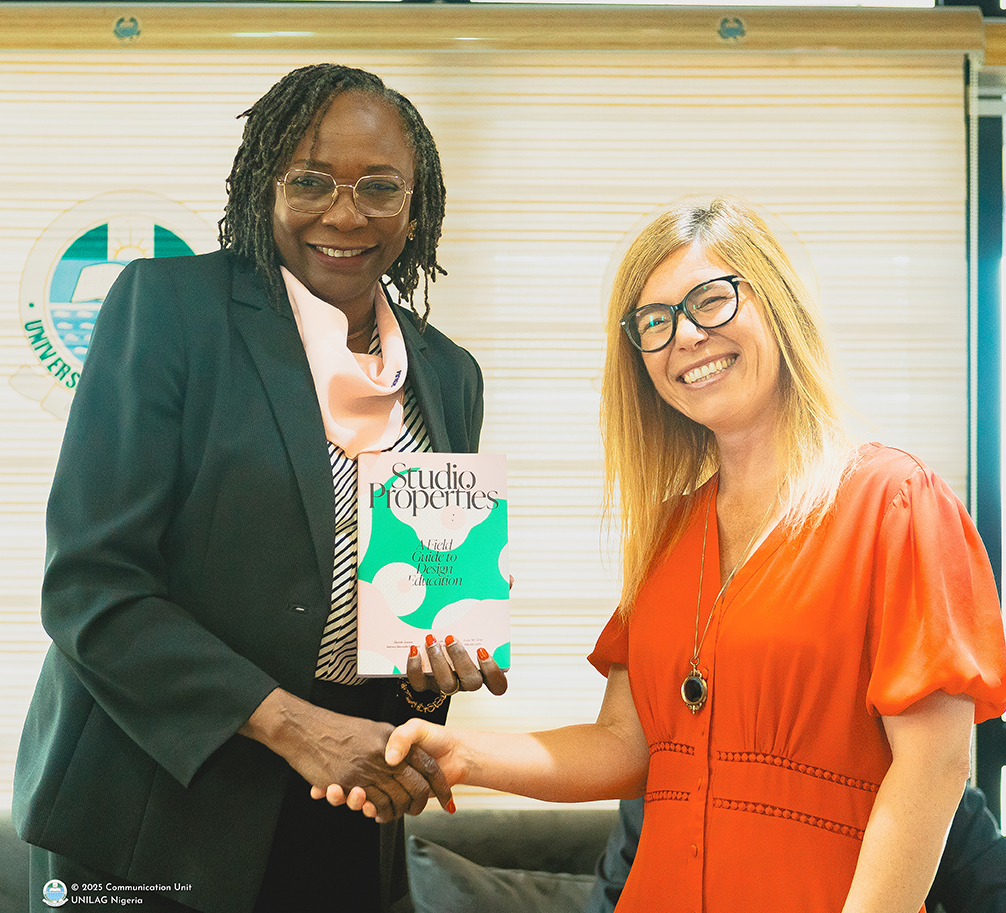
    During our conversation, and later in her opening address, Professor Ogunsola shared a perspective that resonated deeply with me. She spoke about how distance and online learning in Nigeria often fails to support the human and social dimensions of education. She lamented the absence of atmosphere, social interaction, and a sense of place, identity, and belonging in current digital learning platforms.

    Naturally, I presented her with a copy of the Studio Properties book, suggesting that she might find inspiration in the principles of educational design studios.

    The properties outlined in the book are not limited to in-person learning environments. They are equally relevant to hybrid, blended, and distance learning because they reflect the foundational principles of studio learning. For me, the real power of the book lies in how it connects individual Studio Properties and helps the reader form their own ideas about more holistic, humane learning experiences.

    In our brief exchange, I identified at least seven studio properties highlighted in [Bold]:

    Simply being together in a collective [Collective learning], comprising students from different year groups and specialisations, increases students’ awareness of the surrounding activities, creates chance encounters [Serendipity] and prepares them to act on opportunities to design together. A shared [Place] and shared materials and [Artefacts] offer opportunities for interactions and [Dialogue]. 

    Online learning environments don’t necessarily struggle with embedding those individual properties. The challenge lies in weaving them together to create a cohesive, meaningful experience, a true [Place of identity] and [Belonging] that goes beyond the functional interface.

  • Building confidence in studio: How design students find their voice

    Building confidence in studio: How design students find their voice

    Experienced designers know how to present their projects and explain their thinking to clients. The educational design studio is a practice run for that, building not only students’ skills but also their confidence to speak. Instead of clients, students present to tutors, peers, and sometimes even outside guests. As practitioners, tutors or researchers, it’s easy to forget just how intimidating it can be to stand up and talk about your own work. I remember doubting myself in studio, wondering if my idea was any good, if my prototype was worth showing, or if I was even using the right words. That’s why we wrote the Studio Property ‘Confidence to speak’.

    Students pick up the language of design over time. They learn how to talk about their work, the right words to use, and when to use them. The more time you spend in the studio, joining in on chats, crits, and presentations, the more you pick up on the shared language and get the confidence to speak. Just listening in on group crits or watching how others present helps you figure out what’s expected. You compare yourself with others, which is a key property of studio that helps you learn.

    If we want students to feel more confident speaking up in the studio, we as practitioners or educators need to be careful with the words we use. We should use language that matches the group’s level, then slowly bring in more design terms as everyone gets more comfortable. Over time, this helps students shift how they talk about their work.

    One of the good things about design is that it’s all about making and having something visual or physical to talk about makes it so much easier to get a conversation going. Having an artefact to point to or explain helps keep the conversation flowing and gives everyone something to focus on.

    Some students are happy to talk about their work when they’re proud of it, while others might speak up because they’re curious to hear what someone else thinks about their ideas. If you’re skilled at something, you’ll naturally feel more confident, and as you get better, you’ll become more of an expert. But being confident to speak isn’t just about having the right words or a finished project. It’s also about knowing what you’re good at and where you might need a bit more help. Still, the best designers are those who are confident enough to admit when they don’t know something or when they’ve got more to learn. Confidence to speak is about learning to ask the right design questions.