
Author: James_B

  • Conference report: European Association for Architectural Education (EAAE) 2025 ‘Transhistorical Pedagogies’

    Conference report: European Association for Architectural Education (EAAE) 2025 ‘Transhistorical Pedagogies’

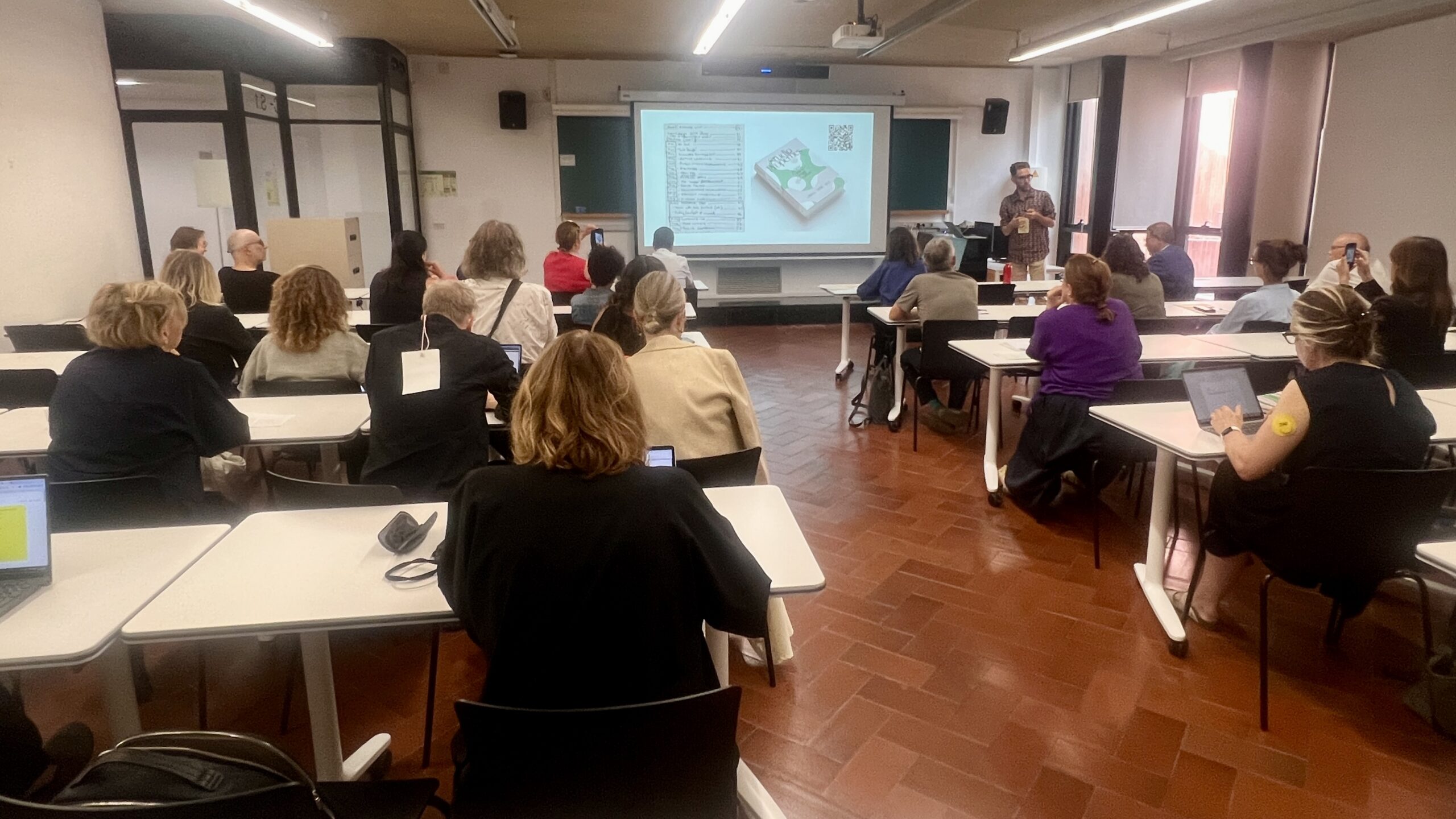
    At the end of every August, the European Association for Architectural Education (EAAE) holds its annual conference and general meeting.

    This year, the conference was hosted by the Escola Técnica Superior d’Arquitectura de Barcelona (ETSAB) at the Universitat Politècnica de Catalunya (UPC) under the theme of Transhistorical Pedagogies.

    We submitted a paper to Session 4 Skills and Crafts. We took a particular interest in this part of the session’s call for papers:

    “Critical thinking and design processes applied to architecture, cities and landscapes require a slow pace. True understanding in these fields requires depth of learning and sedimentation. In a society that values quick results and instant gratification, this commitment to a more deliberate process is radical, even subversive.”

    We decided to use this call as an opportunity to present and discuss some of the unpublished research from the book – while also shamelessly promoting the book in its first week of sales. We introduced the book by looking in detail at the cluster Time and Structures, in which the properties Immersion, Time, Rhythms, Synchronicity & Proximity, and Project Cycles all address how the meta-, mesa- and micro-rhythms of studio intersect and interfere with one another to affect the educator’s and student’s experience of studio.

    Although we did not name it in the book, we used the conference paper to conceptualise this as the polyrhythmic studio as a means to speculate on how the differing scales of rhythm combine for every student and educator to create a highly personal experience of studio. The challenge for educators is that such time-based architectures are very often invisible, tacit, and assumed, meaning they can be easily dismissed when under-resourced or under cost pressure in the contemporary university.

    Studio Properties makes tacit and explicit the properties of studio for educators, giving them tools to examine, surface and articulate the value of studio in the face of increasingly commoditised higher education environments. In particular, it recognises the value of studio as offering: the time and place for  immersion and the long durée of a studio experience; the textures of activity in studio as rhythms acting as curricular entities; student agency to create their own learning spaces. Studio Properties challenges reductive ideas of education as immediate, standardised, or transactional and instead argues for the value of studio as a deliberate – and we might suggest – polyrhythmic pedagogy. 

    Our paper will be further developed based on feedback from conference delegates and will be published in the proceedings later in time for the next conference in August 2026.

    Sincere thanks to the conference organisers, scientific committee and delegates for an engaging and enjoyable conference. And for supplying chilled Cava in the 36° heat.

    Photo: Mia Roth.
  • Critical pedagogy

    All the properties in Studio Properties are phenomena you might encounter in a design studio in an educational institution. Some of them you might never have experienced, and some you might encounter every day.

    Some are different, in the sense that they are properties of many educational environments, not just studio. In the cluster Cultures and Power the property Critical Pedagogy rests on extensive bodies of knowledge from a range of educational contexts.

    Critical pedagogy names and addresses the inequities and injustices in education. It is an approach to education that regards teachers and students as equally responsible for co-creating the curriculum. Fundamentally, critical pedagogy seizes the political potential of education as means of liberating both teachers and students from forms of oppression.

    Like many teachers who identify with the tenets critical pedagogy, I first encountered Paulo Freire’s Pedagogy of the Oppressed as a student, in my case during a seminar course at the University of Sheffield taught by Rosie Parnell, now Professor of Architecture and Pedagogy at Newcastle University. Rosie included the book as part of a wide ranging reading list that allowed us as Masters students the opportunity to interrogate the extent to which we were in control of the form and content of the knowledge we were learning.

    Freire based his writing on a model of literacy education for rural farmers (far removed from studio education in architecture). Much of what has followed in my subsequent two decades of educational research and practice has been related to a fundamental question: to what extent can architectural education fully engage with the principles of critical pedagogy? And I am living up to the liberatory principles of critical pedagogy in my own teaching?

    What is perhaps most exciting about critical pedagogy in studio is its possibility for supporting teachers and students to collaboratively build a framework for embodied and empathetic action, one which is simultaneously pedagogical and political.

    Educators in design disciplines can engage with the principles and values of critical pedagogy in various ways. As a Masters student, I first started to think practically about applying critical pedagogy to design education during annual live projects at the University of Sheffield School of Architecture. These six-week-long projects introduced groups of students to a real client and community outside the university. Sometimes these groups both designed and built small structures for their clients, but in many cases, their work was focused on researching and presenting feasibility studies or design proposals that the client could then take forward. By developing a response to a real person, a real situation and a real need (as opposed to a theoretical design brief written by a teacher or the student themselves) students are exposed to the complexity and richness of designing in the real world. They develop empathy for the clients and communities they work with, and their design work becomes embodied.

    Live projects were already the subject of doctoral research, notably Rachel Sara who coined the concept of them existing ‘between the studio and the street’. Her work emphasises that while live projects give students an opportunity to design outside the simulacra of design practice in the studio, they also reinvigorate the studio as a place of critical reflection and discussion.

    In my subsequent research, I came to understand live projects as critiques of normative educational models. By engaging students with the world outside the studio, live projects require students to critically examine their assumptions about the knowledge and skills required by the curriculum. 

    As we explain in the property Critical Pedagogy, while critical pedagogy can be a property of studio, it is not an innate property of studio. Furthermore, while certain aspects of critical pedagogy can be found in studio practices and approaches which are widespread – they are not always recognised as such. We have observed many studios operating which seem to be opposed to the principle of teachers and students being co-creators of a curriculum of liberation. This may be understandable – to be a critical pedagogue in studio requires determination to overcome the deeply embedded power structures of the university.

  • Conference report: Association of Architectural Educators (AAE)  2025. Nurture: cultivating care, creativity & collaboration in architecture.

    Conference report: Association of Architectural Educators (AAE) 2025. Nurture: cultivating care, creativity & collaboration in architecture.

    With the publication of Studio Properties little more than a month away, from 9-11th July 2025, I had the pleasure to meet friends old and new at the 2025 AAE conference hosted by the University of the West of England (UWE) outside Bristol, England.

    (Short background: I was a founding committee member of the Association of Architectural Educators, and formerly Assistant Editor and later Editor of its open access journal Charrette. The AAE emerged after the Centre for Education in the Built Environment (CEBE) was dissolved by the Higher Education Academy, and architecture educators came together to form an association to represent their interests and to disseminate their work.)

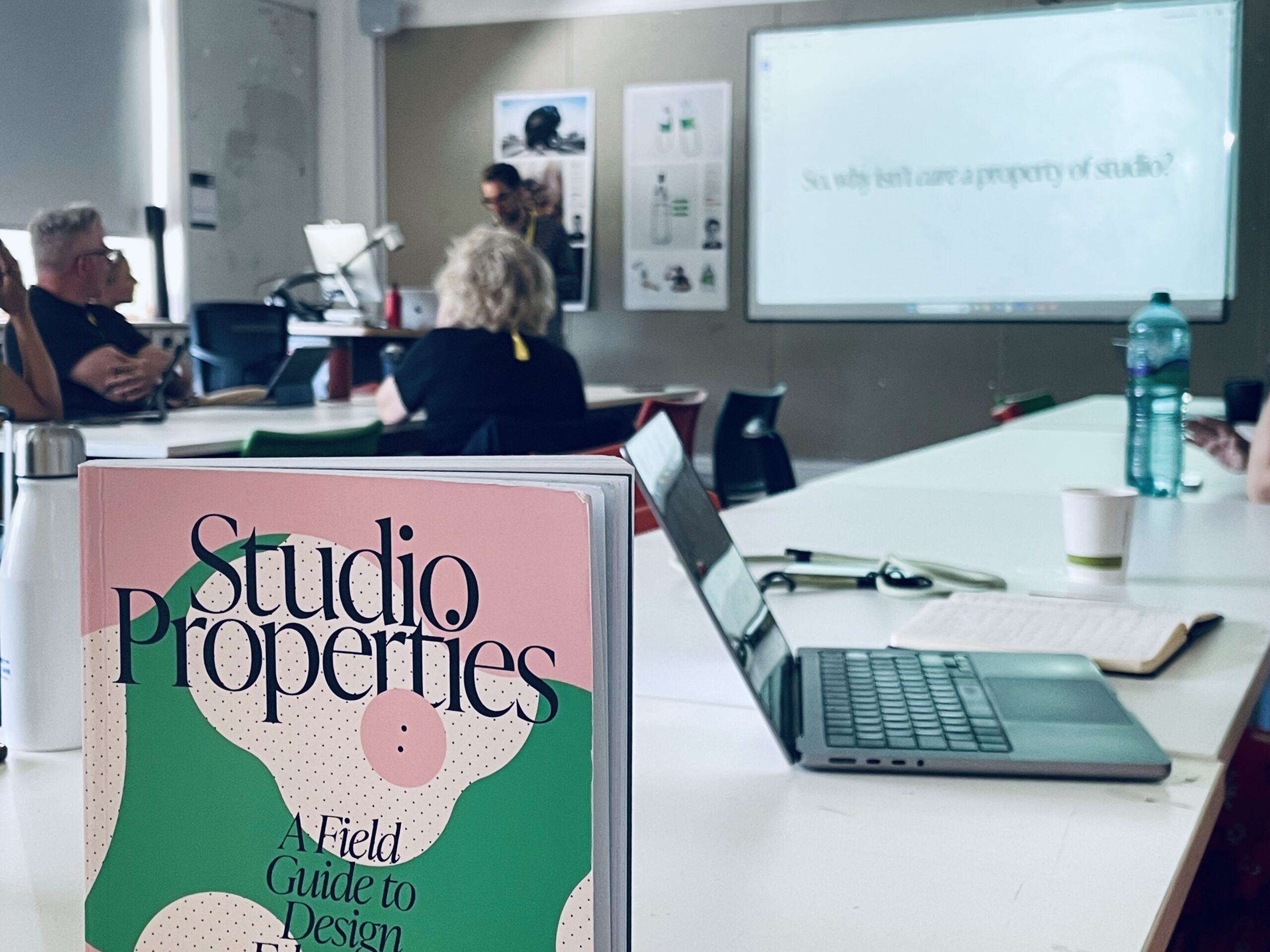
    This was my first AAE conference in many years, but it was also my first time speaking about the book with a printed copy in my hands. It was a delight to be able to introduce the work and hand the book over to the audience. Glimpsing between my notes, the presenter preview and the room, it was a delight to see the book in the hands of some twenty architecture educators from the UK, continental Europe and North America.

    Our paper responded to the conference call (for “contributions that enhance understanding, challenge prevailing assumptions, nurture alternative approaches, push boundaries, cultivate collaborations, and explore and implement innovative ideas”) by critically interrogating a perhaps fundamental oversight in our book: why isn’t care one of our fifty-seven properties of studio?

    We argued that practices of care are rarely explicit in architecture curricula, but can be found in healthy and inclusive studios. We believe that studio, as a place of learning intertwined with its occupants’ emotional states and experiences, constitutes a distinct and exceptional environment for developing pedagogies centred on care.

    During the conference I was informed by a member of staff that UWE currently pays studio teachers a lower hourly rate than those engaged in other modes of teaching (such as lectures). Given the drastic contractions in UK Higher Education, this was a poignant reminder that effective studio education has a high cost in terms of time, facilities, resources, and people. Many universities are turning their attention towards expensive teaching modes and demanding savings. As we argue in our paper, studio educators need a language to explain and defend the values of studio as a place of critical care. We hope that for some, Studio Properties can provide that language.

    Our paper will be further developed based on feedback from conference delegates and will be published in the proceedings later this year.

    Sincere thanks to the conference organisers, scientific committee and delegates for an engaging and enjoyable conference.

    Photo: Craig Stott.